


Luck be a Landlord
TrampolineTales
I went into Luck be a Landlord expecting a small card game with a casino theme, but its real appeal is the way it turns a simple spin into a chain of difficult decisions. You are trying to keep paying rent while building a slot-machine reel from symbols that support one another. The result is part deckbuilder, part roguelike, and part probability puzzle. I found it much more thoughtful than its playful presentation first suggests.
The basic premise is easy to understand: your landlord keeps raising the rent, and every successful round gives you another chance to improve the machine that earns your money. You choose symbols, watch them interact, and decide whether to chase a strong combination or settle for a safer income source. That pressure gives every run a clear purpose. You are not simply collecting cards for their own sake; you are trying to make the next payment before the game catches up with you.
It is a paid card game from TrampolineTales, priced at $4.99, with an Everyone 10+ age rating. That purchase context matters because this is not the kind of game I would approach as a free trial padded with repeated payment prompts. I paid once to play it, and the straightforward entry point makes it easier to judge the design on its own terms. The game has a 4.3 average from around 1.9 thousand ratings and has passed 100 thousand installs, which suggests that its unusual blend has found a substantial audience.
How the slot-machine deckbuilding loop works
Each turn begins with the reel, but the important action happens before and after the spin. You gradually shape the collection of symbols available to you, then watch the result determine your income. Some choices are valuable because they pay well on their own, while others become useful only when surrounded by the right companions. That distinction is where the deckbuilding element becomes meaningful rather than decorative.
I like that the game makes ordinary-looking choices feel consequential. A symbol that seems weak during the first few turns may become the piece that makes a later strategy function. On the other hand, taking too many attractive but unrelated symbols can dilute the machine and make the outcome less dependable. The best runs are not built by grabbing every high-value option. They come from recognizing a direction early and resisting choices that do not help it.
Related News






The slot-machine format also changes how I think about probability. In a conventional card battler, I may plan around a hand and calculate whether I can play a particular sequence. Here, the reel introduces a more visible layer of uncertainty. I can improve the odds through my choices, but I cannot fully control the result. That makes each spin exciting, although it can also make a bad outcome feel more painful when the rent deadline is close.
The game’s central trick is that luck is not the whole strategy. You are constantly trying to turn random results into a reliable engine. That means evaluating symbols by their relationships, not just their individual payout. A modest symbol that repeatedly supports other symbols may be more useful than a flashy one that rarely appears at the right time. This is one of the first non-obvious lessons I took from playing: consistency often matters more than the biggest possible spin.
Runs develop a pleasing rhythm. Early decisions are about establishing income and avoiding immediate collapse. Later decisions become more specialized, because the machine has enough identity for you to commit to a particular direction. When the pieces line up, the game produces satisfying bursts of progress. When they do not, the failure usually teaches me something about overcommitting, taking unnecessary clutter, or ignoring the next payment while chasing a long-term idea.
Gallery
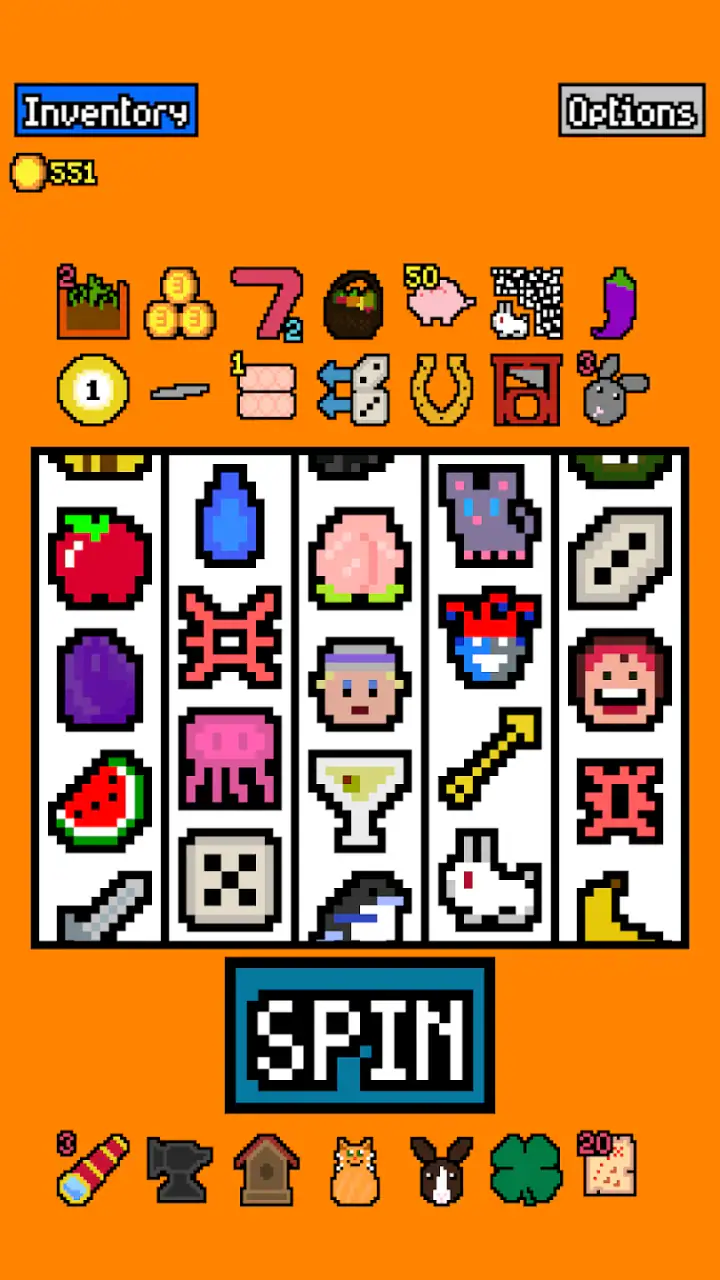
Why the rising rent creates real pressure
The landlord is more than a theme. The rent schedule gives the run its clock. I cannot spend every turn improving the future because the present payment still has to be met. This creates a useful tension between investment and survival: do I choose an option that helps immediately, or do I accept a weaker short-term result because it may unlock a stronger combination later?
That pressure makes the game work well in short sessions. I can play a few turns while waiting for an appointment and still feel that I have made meaningful decisions. A complete run can demand more attention, but the structure naturally breaks into small moments. For an everyday example, I found it suitable for a commute or a quiet break when I wanted something more engaging than a one-minute puzzle but less demanding than a long role-playing session.
The same pressure can be frustrating if I am looking for a relaxing idle experience. There are moments when the machine appears to be improving, only for a poor sequence to leave the next rent payment out of reach. Because the run is built around survival, I cannot always recover by simply waiting. Players who dislike losing progress to unlucky turns may need to approach it as a game of repeated experiments rather than a guaranteed climb.
One practical habit helps: I try to judge every decision by the next rent payment before considering the dream build. That does not mean choosing the safest option every time. It means knowing exactly how much risk I am taking. If the current machine is already producing enough, I can afford to pursue a more ambitious combination. If I am barely covering expenses, a clever future plan is not useful unless it also keeps the run alive now.
Another useful adjustment is to treat the machine as a limited space rather than an unlimited collection. Adding something new can be exciting, but every extra symbol affects the chances of seeing what is already working. I learned to ask whether a new choice improves the whole arrangement or merely looks impressive in isolation. This is a specific trade-off that is easy to miss during the first few runs, especially when a new symbol promises a large payout.
Learning from failed runs instead of chasing perfect luck
The roguelike structure gives failure a productive role. A lost run is not just a failed attempt to reach the end; it is a record of decisions that can be reconsidered. I began noticing patterns in my own mistakes: taking too many conditional symbols, underestimating the cost of a weak early economy, and waiting too long to abandon a strategy that was no longer paying off.
That learning curve is gentler than the casino theme might suggest. The game uses chance, but it does not ask me to spend real money to improve the odds during a run. The purchase is $4.99, and that is the price I associate with entering the game rather than a stake I repeatedly place on individual spins. From a spending perspective, that distinction is important. The financial risk is the upfront purchase, while the in-game tension comes from virtual rent and run failure.
I still would not call every loss perfectly satisfying. Randomness can sometimes obscure whether I made a poor decision or simply received an unfortunate sequence. Over time, however, the broader pattern becomes clearer. Strong play improves the quality of the choices available and the reliability of the machine, even though it cannot eliminate uncertainty. That balance is why I see the game as a strategy title with luck, not as a gambling substitute.
Fairness, spending, and who gets the best experience
For me, the strongest fairness point is the simple purchase model. I can evaluate the game without treating every session as an opportunity to spend more. That makes experimentation more comfortable. I am willing to try an unusual symbol or a risky build because a failed run costs time and progress, not another payment. The design’s pressure comes from the rules of the run, not from a demand to buy relief from them.
That does not mean the game will feel equally fair to everyone. A player who expects direct control may see the random reel as an obstacle, while a player who enjoys probability management will see it as the central challenge. Fairness here depends partly on whether the uncertainty is the kind of uncertainty you came to enjoy. I found it fair when my choices improved my position, but I also had to accept that good choices would not guarantee a good spin.
The game is a good match for people who enjoy building engines from small interactions. It is especially appealing if you like card games where the best decision is not always the card with the largest number. It also suits players who enjoy restarting, testing a new approach, and gradually becoming better at reading a system. The slot-machine presentation gives the process a distinctive personality without removing the need for planning.
I would be more cautious recommending it to someone who wants a traditional card battler with direct attacks, fixed turns, and a clear tactical board. This is not the right choice if you need complete control over every action or if random outcomes quickly spoil your mood. It is also less suitable for anyone looking for a purely social card game, because the appeal comes from solving the run’s economic puzzle rather than competing with friends at a table.
Compared with a standard deckbuilder, this game places more weight on income management and symbol relationships. Instead of focusing mainly on combat damage or a hand of cards, I am building a machine whose results must keep pace with escalating rent. Compared with a conventional slot game, it gives me far more responsibility: the important decisions happen in the choices that shape future spins. That combination is the reason it feels distinct from both categories.
The trade-off is that its unusual structure may take time to explain to another person. If I recommend it to a friend, I describe it as a roguelike deckbuilder where the deck becomes a slot machine and every spin helps pay rent. That explanation is accurate enough to set expectations, but the actual appeal only becomes clear after several decisions. The game is simple to start and harder to master, which is a good combination for patient players but not for someone seeking instant mastery.
Questions I would consider before buying
The first question is whether the paid entry is justified. In my experience, the answer depends on how much you enjoy replaying a ruleset rather than consuming a fixed story. The game’s value comes from repeated runs, different combinations, and improving your judgment. If you only want a short, linear experience that ends once the main content is seen, the purchase may feel less compelling. If you like returning to a system to understand it better, the upfront price is easier to justify.
The second question is whether it is suitable for younger players. Its listed age rating is Everyone 10+, so I would place it in the family-friendly end of strategy gaming while still remembering that the slot-machine theme and landlord pressure may not appeal to every child. The mechanics are more about arithmetic, probability, and planning than realistic gambling, but parents choosing games for a particular child should still consider how that theme fits their preferences.
The third question is whether it requires a large time commitment. I found the turn-based structure comfortable for short sessions because decisions arrive in small units. You can make progress without reserving an entire evening, although the desire to try one more run can extend a break unexpectedly. That makes it flexible, but players who are trying to limit screen time may want to set a stopping point before starting another attempt.
Some readers will also wonder whether the current build is worth installing on an older device. The listed minimum operating system is Android 5.0, and the current version is 1.2.21. Those details make the game approachable for devices that are not new, although actual comfort can still depend on the phone or tablet itself. I would keep the operating system requirement in mind before buying, particularly if the device has not been updated for a long time.
Finally, the developer is TrampolineTales, and the game was released on Jun 30, 2023. I mention those details because they help place the product in context: this is an established paid release rather than a brand-new experiment appearing without a track record. Its audience has grown beyond 100 thousand installs, but popularity alone should not decide the purchase. The more useful question is whether you enjoy the specific combination of chance, deckbuilding, and financial pressure.
My trust verdict after playing through the idea
I trust Luck be a Landlord most when I treat it as a strategy puzzle wearing a slot-machine costume. Its best moments come from seeing a collection of symbols begin to cooperate, then realizing that a small choice several turns earlier made the difference. The game encourages careful observation without pretending that uncertainty can be removed. That is a difficult balance, and it gives the runs their identity.
My main reservation is emotional rather than financial. A run can end at a moment when I feel close to stabilizing, and the random reel can make that ending feel harsher than a purely tactical mistake. I also needed time to understand that adding more options is not automatically progress. Players who want immediate clarity may find the early sessions confusing, while experienced deckbuilder fans will probably recognize the satisfaction once the relationships between symbols start to make sense.
The spending side is easier to evaluate: it is a $4.99 game, and I experienced the core appeal as a one-time purchase rather than a cycle of escalating payments. That does not make it universally right for every budget, but it gives the decision a clear boundary. You are deciding whether this particular replayable card game deserves the price, not whether you want to keep funding a run after it goes badly.
My recommendation is strongest for players who enjoy probability, incremental improvement, and runs that reward reflection after failure. I would suggest skipping it if you dislike randomness, need direct control, or want a conventional card game with opponents and straightforward battles. For everyone else, this is a clever and unusually focused game: the landlord creates the pressure, the reel creates the uncertainty, and your symbol choices determine whether luck becomes a plan.
FAQs for Luck be a Landlord
What is Luck be a Landlord?
Luck be a Landlord is a single-player roguelike deck-building slot machine game. Instead of gambling with real money, you spin a virtual machine to earn rent, then choose symbols to add to your collection. Each symbol has different effects and combinations, so successful runs depend on planning, experimentation, and adapting your strategy as the landlord increases the rent.
Does Luck be a Landlord involve real-money gambling or in-app purchases?
No. The game uses fictional coins and a simulated slot machine, but there are no real-money bets, cash prizes, or gambling transactions required to play. Your progress is based on the choices you make during each run. Depending on the platform and version, the game may be purchased upfront, so users should check the store listing for the current price and availability.
How does the gameplay work?
Each turn gives you a spin, and the symbols that appear generate coins according to their abilities and nearby combinations. After spinning, you select one new symbol from a random group to improve your machine. You must earn enough money to pay rent at regular intervals. If you fail to meet the rent, the run ends, making symbol selection and long-term planning especially important.
Is Luck be a Landlord suitable for beginners?
The basic controls are easy to understand, but the game becomes strategically demanding quite quickly. New players may need several runs to learn which symbols work well together, which items provide useful bonuses, and when a symbol has become inefficient. The game explains many mechanics through descriptions, although some interactions are best discovered through experimentation and repeated play.
Can Luck be a Landlord be played offline, and how much replay value does it offer?
Luck be a Landlord is designed primarily as a single-player experience and can generally be enjoyed without an internet connection after installation, although store-related features may still require connectivity. Its replay value comes from randomized symbol choices, different build possibilities, unlockable content, and increasingly difficult rent requirements. Each run can develop differently, encouraging repeated attempts and experimentation.
Pros
- Highly replayable runs with varied builds and strategies.
- Relies on planning and probability rather than fast reflexes.
- Distinct symbols create interesting synergies and combos.
- Runs are easy to pause and continue in short sessions.
- Strong pixel-art style and charming visual presentation.
Cons
- Luck-based outcomes can make some runs feel frustratingly unpredictable.
- The learning curve may be steep for players new to deck-building games.
- Later floors can feel repetitive after many completed runs.
- Some powerful strategies may overshadow less effective symbol combinations.
- The minimalist presentation may offer limited appeal to action-focused players.


